Secure connections
Save PostgreSQL connection details with encrypted passwords, SSL settings, URL import, testing, search, edit, and delete actions.
Lightweight PostgreSQL client
Nobody searches for a lightweight PostgreSQL client at random. It is what you search after waiting on a Java IDE to start, or watching a browser-based tool reload a panel for the third time. Written by the PgDeck team, and ordered by how light each option actually is rather than by which one we sell.
Short answer: psql is the lightest option and always will be. pgweb and Adminer are the lightest graphical tools, both single binaries or files. Among full desktop clients, native ones — PgDeck for PostgreSQL only, TablePlus for several engines — are meaningfully lighter than anything built on Java or Electron.
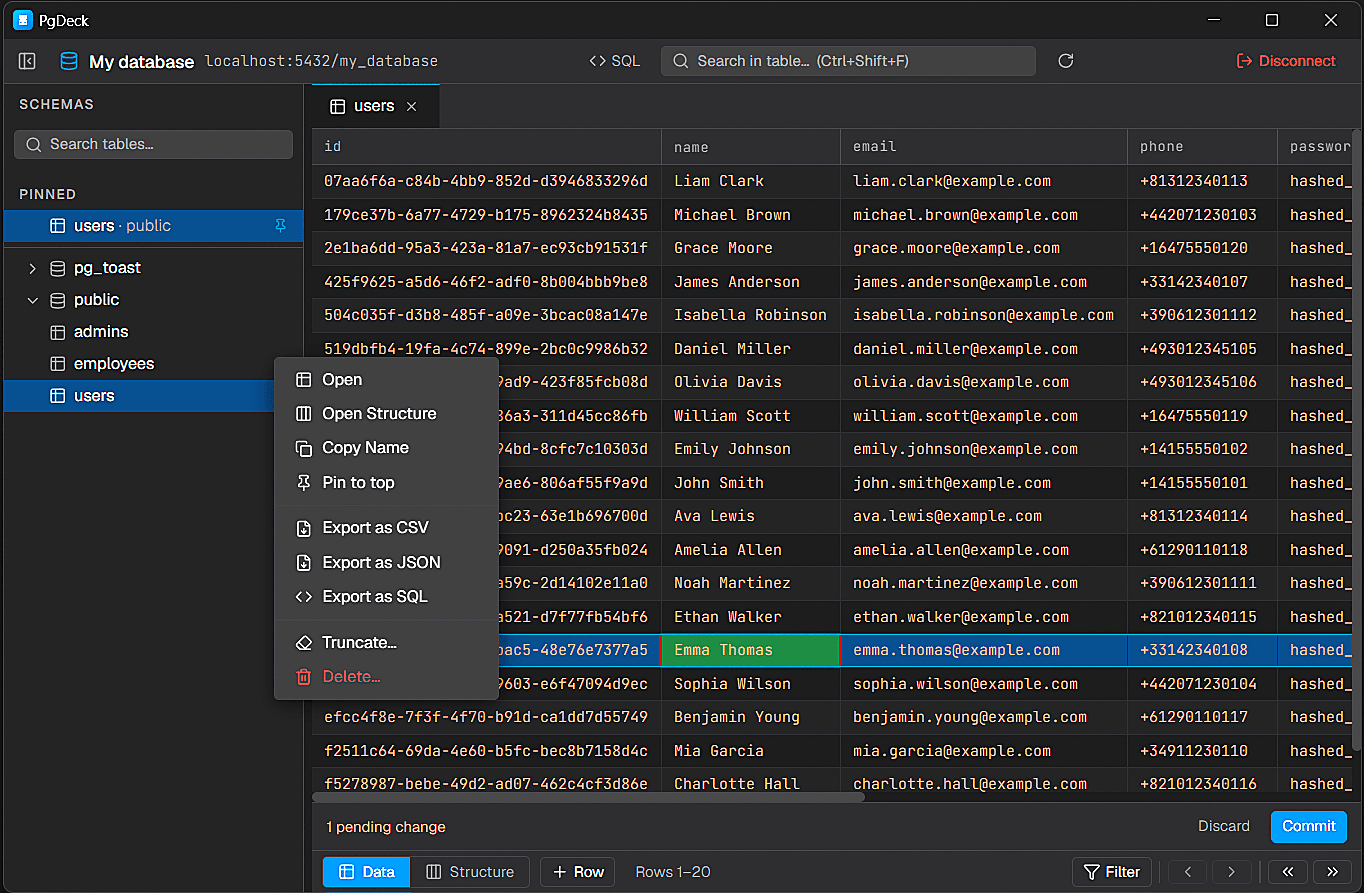
PgDeck is shaped around PostgreSQL tasks that happen every day: connect, inspect, filter, edit, query, manage structure, copy, and export.
Best for: The absolute minimum, and scripting
Already installed wherever PostgreSQL is, starts instantly, uses almost nothing, and works over SSH on a server with no display. Nothing graphical will ever beat it on weight. The cost is the learning curve and that exploring an unfamiliar schema in a terminal is genuinely slower than clicking through one.
Best for: The lightest graphical option
A single Go binary with no dependencies that serves a clean PostgreSQL browser over HTTP. Nothing to install beyond the binary, trivial to run in a container or on a bastion host, and it starts immediately. Intentionally simple — browse, query, export, and not much else. Being a web service, anything network-reachable needs authentication in front of it.
Best for: A database GUI in one file
A single PHP file. Drop it on a server that already runs PHP and you have a working schema browser and query runner in under a minute. Covers several engines. As minimal as graphical tools get, with the same caveat as pgweb: it is an HTTP service holding database access, so do not leave it exposed.
Best for: The lightest full desktop client for PostgreSQL
Native, with one database driver and one engine's worth of interface — no JVM, no bundled web server, no eighty unused drivers. Keeps what people actually miss when they go minimal: multi-tab SQL, query history, ERD, SSH tunnels, backups, and staged edits. Heavier than psql or pgweb by definition, because it is a full application. Ours, so weigh accordingly.
Read the full comparisonBest for: A light native client across several engines
Native code, opens instantly, and covers PostgreSQL alongside MySQL, SQLite, Redis and more. The lightest multi-engine desktop client by a clear margin. It is paid, and the unlicensed version limits open tabs rather than offering a usable free tier.
Read the full comparisonBest for: A simple free client, if Electron is acceptable
Simple, open source, multi-engine, and pleasant. Often recommended as lightweight because the interface is uncluttered, which is not the same thing — it runs on Electron, so it is lighter to read than to run. If your complaint was visual clutter rather than memory, it qualifies. If it was resource use, it does not.
| psql | pgweb | PgDeck | DBeaver | |
|---|---|---|---|---|
| Needs a separate runtime | No | No | No | Yes |
| Graphical interface | No | Yes | Yes | Yes |
| Starts instantly | Yes | Yes | Yes | No |
| Drivers for unused engines | No | No | No | Yes |
| Runs without a display | Yes | Yes | No | No |
| Multi-tab SQL editor | No | Partial | Yes | Yes |
| ERD relationship diagram | No | No | Yes | Yes |
| Staged edits reviewed before commit | No | No | Yes | Partial |
| Backup and restore built in | Partial | No | Yes | Yes |
Assessed September 2026. DBeaver is included as the reference point for a heavy client, not as a criticism — its weight buys eighty-plus engines. Written by the PgDeck team.
Save PostgreSQL connection details with encrypted passwords, SSL settings, URL import, testing, search, edit, and delete actions.
Browse schemas and tables, search the table list, pin favorites, filter rows, sort columns, resize columns, and paginate results.
Run SELECT and non-SELECT statements from multi-tab SQL editors with syntax highlighting and interactive query results.
Edit cells, add rows, duplicate rows, set NULL, stage deletes, review pending changes, and commit everything in one transaction.
A separate runtime, drivers for engines you never open, and a bundled web server. DBeaver and DataGrip carry a JVM and an IDE platform. pgAdmin bundles a server and renders in a browser. Electron apps carry a browser engine. None of this is waste — each buys something real — but if you only use PostgreSQL, you are paying all of it for none of the benefit.
The usual assumption is that a lighter client means giving up features, and that is only true past a point. Dropping a JVM and seventy-nine unused drivers costs you nothing if you never used them. Dropping down to a single PHP file costs you multi-tab SQL, query history, ERD, and backups. Decide which of those you would miss before optimising for the smallest possible thing.
psql stops when you need to explore a schema you do not know. pgweb and Adminer stop when you need an ERD, backups, or reviewed multi-row edits. A native desktop client stops when you need a second database engine, or serious schema refactoring. Pick the lightest tool that clears your actual ceiling rather than the lightest tool overall.
pgweb and Adminer are so easy to deploy that they get left running. They are HTTP services holding access to a database, and exposed database admin interfaces are found by automated scanners quickly. Bind them to localhost and reach them over an SSH tunnel, or put authentication in front, and remove them when the task is done.
If you want the lightest thing that works and you are comfortable in a terminal, use psql — it is already installed. If you want a graphical tool on a server, pgweb. If you want a full desktop client for PostgreSQL without a runtime, that is the gap PgDeck is built for, and we would say so, so treat that as disclosure rather than advice.
More on choosing, comparing, and running a PostgreSQL desktop client.
psql, which ships with PostgreSQL and starts instantly. Among graphical tools, pgweb is a single Go binary and Adminer is a single PHP file. Among full desktop clients, native single-engine applications are lightest because they carry no runtime and no unused drivers.
It runs on Java and the Eclipse platform, which is what allows it to host drivers for eighty-plus database engines as plugins. The start-up time and memory use are consequences of that architecture, not something you can configure away.
Yes. pgweb is a single binary serving a web interface. Adminer is a single PHP file. For a desktop application, a native PostgreSQL-only client avoids the runtime and driver overhead that makes IDE-style tools slow to start.
Only past a point. Removing a Java runtime and drivers for engines you never use costs nothing. Going down to a single-file web tool does cost you multi-tab SQL, query history, ERD, and backups. Choose the lightest tool that still clears what you actually need.
For scripting, migrations, and remote work over SSH, often yes, and it is the fastest option for anything repeatable. It is weaker for exploring a schema you do not know, where clicking through a tree beats remembering \d commands.
PgDeck is not affiliated with pgAdmin, DBeaver, TablePlus, DataGrip, Beekeeper Studio, or their respective owners. All product names, trademarks, and registered trademarks are property of their respective owners. Comparisons describe each tool as we understand it at the date noted on the table; if something here is out of date, tell us and we will correct it.