Secure connections
Save PostgreSQL connection details with encrypted passwords, SSL settings, URL import, testing, search, edit, and delete actions.
PgDeck vs Beekeeper Studio
Both are developer-focused clients that deliberately avoid being database administration suites, which makes them unusually similar in intent. They differ on three things that actually decide it: how many engines, whether the source is open, and how much Postgres-specific depth you get.
Short answer: Choose Beekeeper Studio if you connect to several engines, or if open source matters to you — its Community Edition is free software under a copyleft licence and PgDeck is not. Choose PgDeck if PostgreSQL is your only engine and you want an ERD, bundled pg_dump backups, type-aware Postgres filters, and staged edits committed as one transaction.
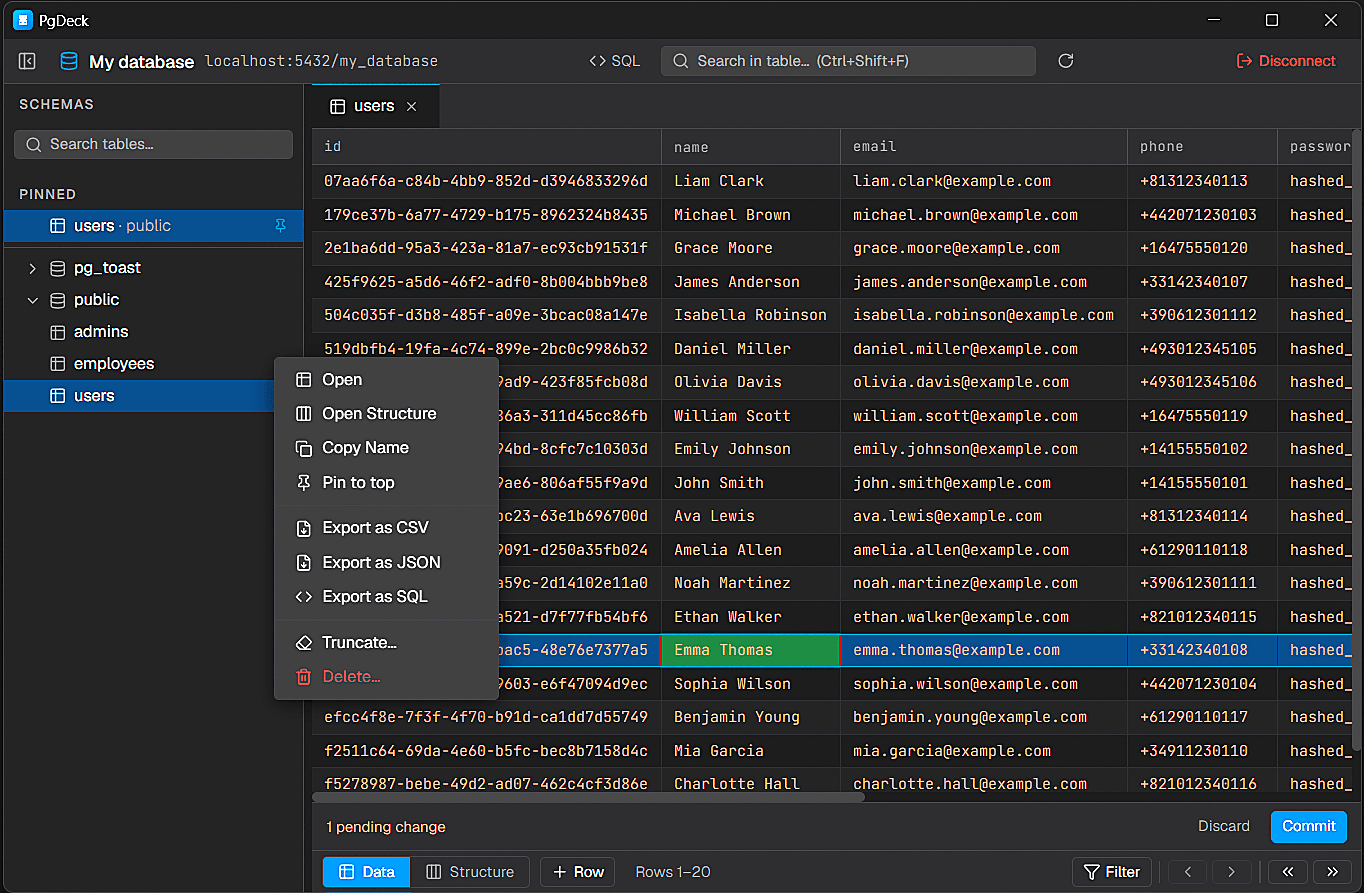
PgDeck is shaped around PostgreSQL tasks that happen every day: connect, inspect, filter, edit, query, manage structure, copy, and export.
PgDeck is an independent PostgreSQL desktop client. This page compares PgDeck with Beekeeper Studio to help developers understand differences in workflow, interface, and product focus.
| PgDeck | Beekeeper CE | |
|---|---|---|
| Databases supported | PostgreSQL only | Several engines |
| Open source | No | Yes |
| Free version you can work in | Yes | Yes |
| Saved connections on the free version | 2 | Unlimited |
| Built on | Native desktop app | Electron |
| Staged edits reviewed before commit | Yes | Partial |
| ERD relationship diagram | Yes | No |
| Backup and restore (pg_dump bundled) | Yes | No |
| Type-aware PostgreSQL filters | Yes | Partial |
| SSH tunnel connections | Yes | Yes |
| Query history and saved queries | Yes | Yes |
| One-time purchase available | Yes | No |
Compared September 2026 against Beekeeper Studio Community Edition. Beekeeper Studio Ultimate is a separate paid product adding engines and features not assessed here. PgDeck is not affiliated with Beekeeper Studio.
Save PostgreSQL connection details with encrypted passwords, SSL settings, URL import, testing, search, edit, and delete actions.
Browse schemas and tables, search the table list, pin favorites, filter rows, sort columns, resize columns, and paginate results.
Run SELECT and non-SELECT statements from multi-tab SQL editors with syntax highlighting and interactive query results.
Edit cells, add rows, duplicate rows, set NULL, stage deletes, review pending changes, and commit everything in one transaction.
Beekeeper Studio's Community Edition is free software with source you can read, audit, and fork. PgDeck is commercial and closed. For a tool that holds credentials to production databases, some teams treat that as decisive before any feature is compared, and that is a reasonable position. It also means Beekeeper's free edition cannot be withdrawn or narrowed by a vendor decision, which PgDeck's free tier could be.
Beekeeper CE gives you unlimited saved connections; PgDeck's free tier caps them at two. If you juggle a dozen environments and do not want to pay, Beekeeper is straightforwardly the better free option. PgDeck's free tier is aimed at someone with a local database and a staging one, with a 30-day Pro trial for evaluating the rest.
Beekeeper generalises across engines, so a filter offers generic operators and search is a generic contains. PgDeck describes PostgreSQL only: true and false for a boolean, a date input for a timestamptz, ILIKE for case-insensitive search, JSONB opened in a real editor, and a column inspector showing Postgres types, defaults, and indexes. It also ships an ERD from your foreign keys and bundles pg_dump and pg_restore, neither of which Beekeeper has.
Beekeeper also holds changes before applying them, so this is a difference of degree rather than kind. PgDeck makes the pending set the object you review: every queued edit, insert, duplicate, NULL, and delete listed together and committed in one transaction, so a correction spanning six rows either lands completely or not at all. On production data that distinction matters; on a dev database it mostly does not.
Beekeeper is built on Electron. PgDeck is a native desktop application. In practice the gap is smaller than the argument about it suggests, and if Beekeeper feels fine on your machine this is not a reason to switch. It shows up mainly in start-up time and memory with several connections open.
More on choosing, comparing, and running a PostgreSQL desktop client.
Beekeeper Studio is an open source multi-engine client with a generous free Community Edition. PgDeck is a commercial PostgreSQL-only client with a limited free tier, adding an ERD, bundled pg_dump backups, type-aware Postgres filters, and staged edits committed as a single transaction.
Yes. Beekeeper Studio Community Edition is free and open source with unlimited saved connections. Beekeeper Studio Ultimate is a separate paid product adding more engines and features.
No. PgDeck is commercial software with a free tier. If source availability is a requirement for tools holding your database credentials, Beekeeper Studio Community Edition is the better choice and this page will not argue otherwise.
Not at the time of writing. PgDeck generates an ERD from your foreign keys and bundles pg_dump and pg_restore so backup and restore work without a separate PostgreSQL installation.
Beekeeper Studio, for most people. Its Community Edition is open source with unlimited saved connections, where PgDeck's free tier caps connections at two and keeps staged editing, ERD, backups, and SSH tunnels behind Pro.
PgDeck is not affiliated with pgAdmin, DBeaver, TablePlus, DataGrip, Beekeeper Studio, or their respective owners. All product names, trademarks, and registered trademarks are property of their respective owners. Comparisons describe each tool as we understand it at the date noted on the table; if something here is out of date, tell us and we will correct it.