Secure connections
Save PostgreSQL connection details with encrypted passwords, SSL settings, URL import, testing, search, edit, and delete actions.
Best free PostgreSQL GUI
There is an important difference between free and free-to-start, and most lists of free PostgreSQL tools blur it. The first five entries below are free software with no paid tier above them. Anything freemium is labelled as such, including ours.
Short answer: pgAdmin 4 is the best free PostgreSQL GUI overall: official, complete, and open source with no paid edition. DBeaver Community Edition is the best free option if you also use other database engines. Beekeeper Studio Community Edition is the simplest. Adminer and pgweb are the best choices when you need a GUI on a server rather than a laptop.
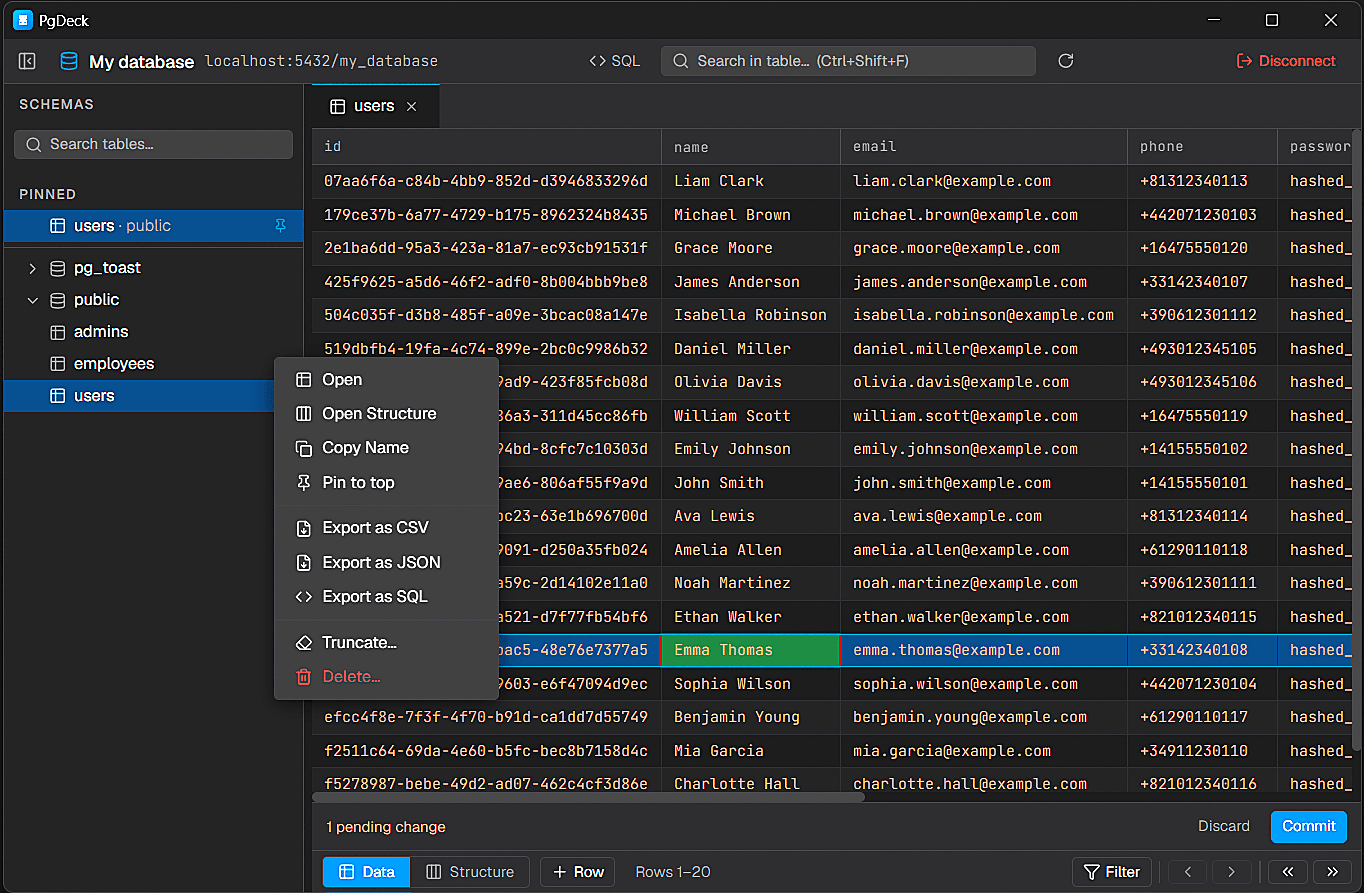
PgDeck is shaped around PostgreSQL tasks that happen every day: connect, inspect, filter, edit, query, manage structure, copy, and export.
Best for: The most complete free PostgreSQL GUI
The official tool, maintained by the PostgreSQL community, and the only one here that covers roles, privileges, tablespaces, server configuration, session monitoring, backup and restore, and an ERD. Nothing on this list matches its feature coverage and nothing is more certain to stay free. The cost is that it is a web application even in its desktop packaging, so routine table browsing feels heavier than a native app.
Read the full comparisonBest for: Free coverage of Postgres and every other engine
Genuinely capable free software: eighty-plus engines, deep schema introspection, ERD, and cross-engine data transfer. A desktop app, so it avoids pgAdmin's browser overhead. It runs on Java and the Eclipse platform, so it starts slowly and its interface is dense because it must describe every engine it supports. DBeaver PRO is a separate paid product — CE is not a trial.
Read the full comparisonBest for: The simplest free GUI to start with
The friendliest interface of any free option and a good first database GUI. Open source, covers several engines, and pleasant for straightforward browsing and queries. Deliberately shallow next to pgAdmin and DBeaver on schema introspection and administration, and some features sit behind the paid Ultimate edition.
Best for: A GUI on a server, in one file
A single PHP file you drop onto a server, giving you a working schema browser and query runner in minutes. Ideal when the database is somewhere you cannot install desktop software. Minimal by design: no ERD, no staged editing, no administration. Anything you expose over a network becomes an access-control problem you now own, so put it behind authentication.
Best for: A zero-dependency browser GUI for PostgreSQL
A single Go binary with no dependencies that serves a clean PostgreSQL browser over HTTP. Easier to deploy than pgAdmin and far lighter, which makes it a good fit for containers and bastion hosts. PostgreSQL-only and intentionally simple — query, browse, export, and little else.
Best for: A native Postgres GUI when two connections is enough
Ours, and freemium rather than free, which is why it is below the open source options rather than above them. The free tier is a tier and not a trial: two saved connections, schema browsing, type-aware filters, a basic SQL editor, and CSV/JSON export, with no tab limits and no expiry. Staged editing, unlimited connections, SSH tunnels, ERD, and backups are paid. There is also a 30-day Pro trial that needs no card.
Read the full comparison| pgAdmin | DBeaver CE | Beekeeper CE | Adminer | |
|---|---|---|---|---|
| Free forever, no paid tier above | Yes | Partial | Partial | Yes |
| Open source | Yes | Yes | Yes | Yes |
| Desktop app | No | Yes | Yes | No |
| Runs on a server | Yes | No | No | Yes |
| ERD relationship diagram | Yes | Yes | No | No |
| Backup and restore UI | Yes | Yes | No | No |
| Server roles and configuration | Yes | Partial | No | No |
| Other database engines | No | Yes | Yes | Yes |
| Suitable for a first-time user | Partial | No | Yes | Yes |
Assessed September 2026. DBeaver and Beekeeper Studio are marked partial on the first row because each has a separate paid edition, though the free editions are not trials. Written by the PgDeck team, whose own free tier is freemium and listed as such.
Save PostgreSQL connection details with encrypted passwords, SSL settings, URL import, testing, search, edit, and delete actions.
Browse schemas and tables, search the table list, pin favorites, filter rows, sort columns, resize columns, and paginate results.
Run SELECT and non-SELECT statements from multi-tab SQL editors with syntax highlighting and interactive query results.
Edit cells, add rows, duplicate rows, set NULL, stage deletes, review pending changes, and commit everything in one transaction.
Free software has no paid edition and no vendor who can change that — pgAdmin, Adminer, and pgweb. A free edition is real free software alongside a separate paid product, which is DBeaver CE and Beekeeper CE. A free tier is a limited slice of a commercial product, which is what PgDeck offers. A free trial is not free at all, just deferred. Lists that mix these are how people end up reinstalling three weeks later.
Less than you would expect. pgAdmin covers administration more thoroughly than most paid clients. DBeaver CE covers more engines than any paid tool on a comparable list. What free tools tend to lack is interface polish and the specific safety features paid clients build as differentiators — staged edits reviewed before commit being the common one. If speed of use matters more to you than feature coverage, that is where paid tools earn their money.
A vendor can change a free tier, raise a price, or shut down. An open source licence already granted cannot be withdrawn, and the source can be audited — which matters when the tool holds credentials to production databases. For a tool you intend to standardise a team on, this is worth more than a feature row.
Adminer and pgweb are excellent when the database is somewhere you cannot install software. They are also HTTP services holding database access, so anything reachable on a network needs authentication in front of it and should not be left running once you are done. Exposed database admin interfaces are a standing category of breach, and a single PHP file is very easy to forget about.
If you want the best free PostgreSQL GUI and cost is the binding constraint, install pgAdmin. It is free permanently, it is official, and it covers more than anything else on this page. Add a lighter client alongside it if browsing feels slow. That advice does not favour us, and it is still the right advice.
More on choosing, comparing, and running a PostgreSQL desktop client.
pgAdmin 4. It is official, free and open source with no paid tier, and it covers more than any other free option — administration, backups, ERD, and monitoring included. If you also use other database engines, DBeaver Community Edition is the better free choice.
Yes. pgAdmin is free and open source software maintained by the PostgreSQL community. There is no paid edition, no feature-limited tier, and no vendor who can change that later.
No. DBeaver CE is free and open source and does not expire. DBeaver PRO is a separate commercial product with additional features; it is not an upgrade you are required to buy to keep using CE.
Yes. pgAdmin runs as a web application, Adminer is a single PHP file, and pgweb is a single Go binary that serves a web interface. All three are free and open source. Put authentication in front of any of them that is reachable over a network.
Yes, a free tier rather than a trial: two saved connections, schema browsing, type-aware filters, a basic SQL editor, and CSV/JSON export, with no expiry and no tab limits. Staged editing, unlimited connections, SSH tunnels, ERD, and backups require Pro. A 30-day Pro trial is available with no card. It is freemium, not free software, which is why this page ranks it below the open source options.
PgDeck is not affiliated with pgAdmin, DBeaver, TablePlus, DataGrip, Beekeeper Studio, or their respective owners. All product names, trademarks, and registered trademarks are property of their respective owners. Comparisons describe each tool as we understand it at the date noted on the table; if something here is out of date, tell us and we will correct it.