Secure connections
Save PostgreSQL connection details with encrypted passwords, SSL settings, URL import, testing, search, edit, and delete actions.
Best PostgreSQL clients
Most PostgreSQL client comparisons are advertisements. This one is written by the team behind PgDeck, so read it with that in mind - but the recommendations below are honest about where another tool is the better choice.
Short answer: There is no single best PostgreSQL client, because the tools split by job. pgAdmin is best for server administration and is free. DBeaver is best if you use several database engines. TablePlus is best for a polished multi-engine native app. DataGrip is best inside JetBrains. PgDeck is best for reading, filtering, and safely correcting Postgres table data all day.
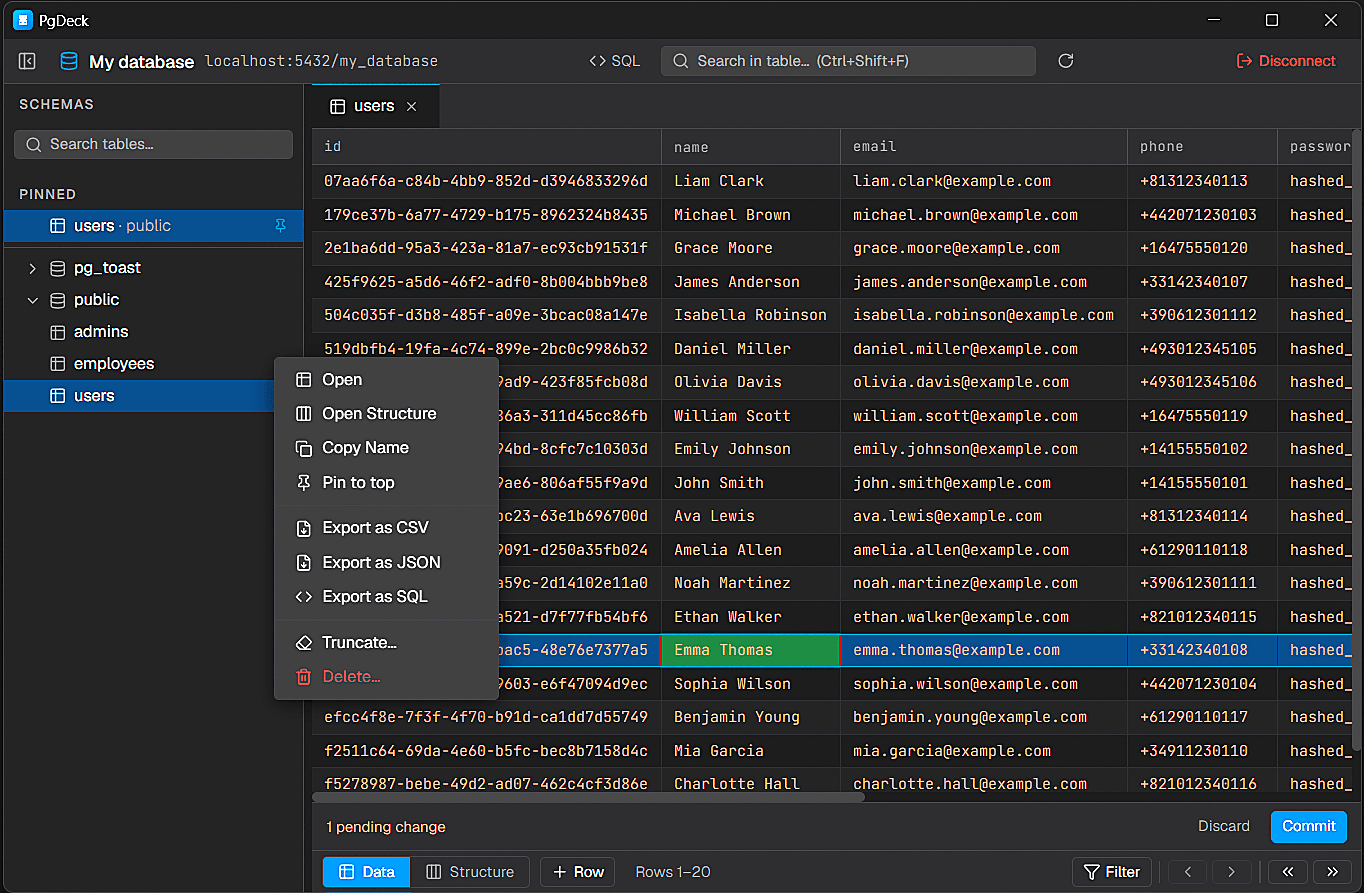
PgDeck is shaped around PostgreSQL tasks that happen every day: connect, inspect, filter, edit, query, manage structure, copy, and export.
Best for: PostgreSQL server administration
The official tool, free permanently, and the most complete for roles, privileges, tablespaces, configuration, backups, and the server activity dashboard. Nothing else on this list covers that ground properly. It is a web application, which is why so many developers pair it with a native client rather than living in it all day.
Read the full comparisonBest for: Working across many database engines at once
Eighty-plus engines, cross-engine data transfer, deep schema tooling, and a Community Edition that is free and open source and genuinely capable. The cost is weight and density: it runs on Java and the Eclipse platform, and its interface has to describe every engine it supports rather than just Postgres.
Read the full comparisonBest for: Reading, filtering, and correcting Postgres table data daily
PostgreSQL only, so filters know Postgres types and search uses ILIKE rather than a generic contains. Row changes are staged as one reviewable set and committed in a single transaction, which is the specific gap it exists to fill. Includes ERD, bundled pg_dump backup and restore, SSH tunnels, and query history. It has no server administration and connects to no other engine.
Read the full comparisonBest for: A polished native app covering several engines
Well-built, fast, and the interface people cite when they say a database client feels good. Covers PostgreSQL, MySQL, SQLite, Redis and more. No ERD and no bundled backup tooling, and the unlicensed version limits open tabs rather than offering a usable free tier, so evaluating it properly means buying it.
Read the full comparisonBest for: Teams already standardised on JetBrains IDEs
By some distance the strongest SQL editing experience here: real completion, refactoring, and schema-aware analysis. If you already work in IntelliJ or PyCharm, the consistency alone justifies it. It is a full IDE, so it carries IDE weight and IDE pricing, and it is aimed at people writing queries rather than clicking through rows.
Best for: The simplest possible interface
Open source, multi-engine, and the friendliest UI in this group. A good first database client and a good answer if density is what drove you away from something else. Deliberately shallower than pgAdmin or DBeaver on schema introspection and administration.
PgDeck is an independent PostgreSQL desktop client. This page compares PgDeck with other PostgreSQL clients to help developers understand differences in workflow, interface, and product focus.
| PgDeck | pgAdmin | DBeaver | TablePlus | |
|---|---|---|---|---|
| Price | Free tier, Pro paid | Free | Free CE, PRO paid | Paid licence |
| Native desktop app | Yes | No | Partial | Yes |
| PostgreSQL-only interface | Yes | Yes | No | No |
| Staged edits reviewed before commit | Yes | No | Partial | Partial |
| ERD relationship diagram | Yes | Yes | Yes | No |
| Backup and restore built in | Yes | Yes | Yes | No |
| SSH tunnel connections | Yes | Yes | Yes | Yes |
| Server roles and configuration | No | Yes | Partial | No |
| Other database engines | No | No | Yes | Yes |
Assessed September 2026 against each tool's freely available edition. Written by the PgDeck team — judge the PgDeck column accordingly, and tell us if any other row is wrong.
Save PostgreSQL connection details with encrypted passwords, SSL settings, URL import, testing, search, edit, and delete actions.
Browse schemas and tables, search the table list, pin favorites, filter rows, sort columns, resize columns, and paginate results.
Run SELECT and non-SELECT statements from multi-tab SQL editors with syntax highlighting and interactive query results.
Edit cells, add rows, duplicate rows, set NULL, stage deletes, review pending changes, and commit everything in one transaction.
Every client here has a feature list long enough to look sufficient. What separates them is the task you do fifty times a week. Administering servers points to pgAdmin. Opening several engines points to DBeaver or TablePlus. Writing complex SQL inside a JetBrains IDE points to DataGrip. Reading, filtering, and correcting Postgres table data points to a single-engine desktop client.
pgAdmin is really two products sharing a window: an administration console and a data browser. Most of the friction people report comes from using the data half of an administration tool all day. Recognising which half your job lives in is the single most useful thing you can do before picking a client — and it is a valid answer to install both.
A client supporting eighty engines has to describe the union of all of them: generic filter types, generic search, generic schema concepts. That is the right trade if you genuinely open MySQL and Redis alongside Postgres. It is a pure cost if you do not. Count the engines you actually opened in the last six months before paying for breadth.
On production data the risky moment is not a missing feature, it is an UPDATE you did not mean to run. Clients differ in how much they make you look before you write: some commit a cell as soon as you leave it, some hold changes per grid, and some hold the whole pending set for review and commit it in one transaction. If you work on live data, weigh this above the feature table.
A desktop client stores connection details on your machine, ideally in the operating system keychain. A server-hosted tool stores them wherever it is deployed, which becomes a shared-secret problem the moment more than one person uses it. For production databases this is worth deciding deliberately rather than by default.
More on choosing, comparing, and running a PostgreSQL desktop client.
pgAdmin and DBeaver Community Edition are the two strongest free options and both are open source. pgAdmin is better for server administration; DBeaver is better if you also use other database engines. Beekeeper Studio's Community Edition is the simplest free option. PgDeck has a free tier covering two saved connections, schema browsing, filters, a basic SQL editor, and CSV/JSON export.
Yes, for administration. pgAdmin covers roles, backups, and server configuration more completely than most desktop clients. Many developers run it alongside a lighter client for daily table work.
A single-engine desktop client is usually fastest, because the interface is not shared with other database types. That is the specific gap PgDeck is built for.
Yes. PgDeck ships a macOS disk image alongside the Windows installer and the Linux AppImage. The download page always lists current platform availability.
Often, yes, and it is not a failure of tooling. Administration and daily data work pull in different directions, so a common setup is pgAdmin for roles, configuration, and backups plus a native client for the table work. Clients do not install anything into your database, so running two costs nothing but disk space.
Weight the one that makes you review changes before they are written. On production the risk is an unintended UPDATE, not a missing feature, so a client that holds the whole pending change set for review and commits it in one transaction is worth more than a longer feature list.
PgDeck is not affiliated with pgAdmin, DBeaver, TablePlus, DataGrip, Beekeeper Studio, or their respective owners. All product names, trademarks, and registered trademarks are property of their respective owners. Comparisons describe each tool as we understand it at the date noted on the table; if something here is out of date, tell us and we will correct it.