Secure connections
Save PostgreSQL connection details with encrypted passwords, SSL settings, URL import, testing, search, edit, and delete actions.
Beekeeper Studio alternative
Beekeeper Studio is the friendliest database client most people try, and its Community Edition is genuinely free. People move on when they hit its depth ceiling — no ERD, limited schema introspection, no administration — or when they want a tool that does not run on Electron. Written by the PgDeck team, with the trade-offs for each option.
Short answer: DBeaver is the answer if you outgrew Beekeeper's depth and want to stay on free software. TablePlus is the answer if you liked the simplicity and want it faster and more polished. PgDeck is the answer if PostgreSQL is your only engine and you want staged editing and an ERD. pgAdmin is the answer if you need server administration.
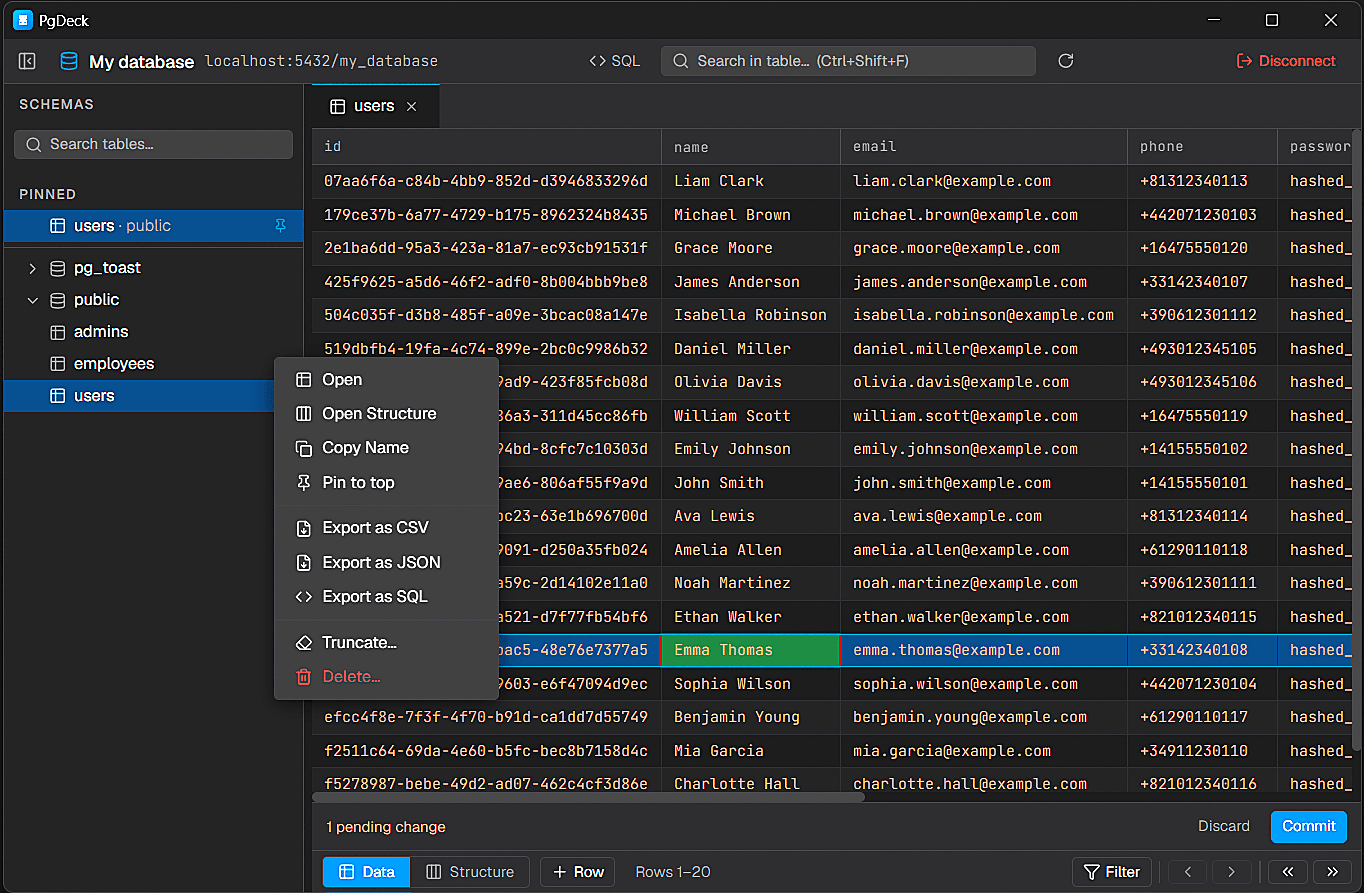
PgDeck is shaped around PostgreSQL tasks that happen every day: connect, inspect, filter, edit, query, manage structure, copy, and export.
Best for: Outgrowing Beekeeper's depth without starting to pay
The natural next step: free and open source like Beekeeper CE, but with far deeper schema introspection, ERD, execution plans, cross-engine data transfer, and eighty-plus engines. You lose exactly what made Beekeeper pleasant — it is dense, it runs on Java and Eclipse, and it starts slowly. Worth it only if depth is genuinely what you were missing.
Read the full comparisonBest for: Keeping the simplicity but making it native and faster
Closest in spirit to Beekeeper: clean, focused, multi-engine, and aimed at developers rather than administrators. Native rather than Electron, so it is noticeably quicker, and more polished throughout. It is paid, and its unlicensed version limits open tabs, so there is no free edition to fall back on the way Beekeeper has one.
Read the full comparisonBest for: PostgreSQL-only work that needs more than browsing
Adds what Beekeeper leaves out for Postgres users: an ERD from your foreign keys, bundled pg_dump backup and restore, type-aware filters that know Postgres types, and row edits staged as one reviewed transaction. Narrower than Beekeeper — PostgreSQL only, where Beekeeper covers several engines — and freemium rather than open source. Ours, so weigh accordingly.
Read the full comparisonBest for: The administration Beekeeper does not attempt
If you hit Beekeeper's ceiling on roles, privileges, tablespaces, server configuration, or monitoring, pgAdmin is the free and complete answer for PostgreSQL. It is a web application, so it is a step down in feel from Beekeeper's interface — this is a capability upgrade and an experience downgrade at the same time.
Read the full comparisonPgDeck is an independent PostgreSQL desktop client. This page compares PgDeck with Beekeeper Studio to help developers understand differences in workflow, interface, and product focus.
| PgDeck | DBeaver CE | TablePlus | Beekeeper CE | |
|---|---|---|---|---|
| Free version you can work in | Yes | Yes | No | Yes |
| Open source | No | Yes | No | Yes |
| Runs on Electron or a JVM | No | Yes | No | Yes |
| ERD relationship diagram | Yes | Yes | No | No |
| Backup and restore built in | Yes | Yes | No | No |
| Deep schema introspection | Yes | Yes | Partial | No |
| Staged edits reviewed before commit | Yes | Partial | Partial | Partial |
| Server roles and configuration | No | Partial | No | No |
| Other database engines | No | Yes | Yes | Yes |
| Simplicity of interface | Yes | No | Yes | Yes |
Assessed September 2026 against each tool's freely available edition. Beekeeper Studio Ultimate adds paid features not assessed here. None of these projects are affiliated with PgDeck, who wrote this page.
Save PostgreSQL connection details with encrypted passwords, SSL settings, URL import, testing, search, edit, and delete actions.
Browse schemas and tables, search the table list, pin favorites, filter rows, sort columns, resize columns, and paginate results.
Run SELECT and non-SELECT statements from multi-tab SQL editors with syntax highlighting and interactive query results.
Edit cells, add rows, duplicate rows, set NULL, stage deletes, review pending changes, and commit everything in one transaction.
Beekeeper is deliberately simple, so people leave for specific missing things rather than general dissatisfaction. If it was an ERD or backups, PgDeck and DBeaver have them. If it was schema depth or execution plans, DBeaver. If it was roles and server configuration, only pgAdmin. If it was speed, only a native client helps. Naming the ceiling first saves you installing three tools.
Beekeeper Studio's Community Edition is open source, and among the alternatives here only DBeaver CE and pgAdmin are too. TablePlus and PgDeck are commercial and closed source. If being able to audit a tool that holds production credentials matters to you, or if a vendor changing terms later is a risk you do not want, that narrows the list to two before any feature is compared.
Beekeeper runs on Electron and gets criticised for it, but the same criticism applies to a great deal of software developers use happily every day. If it feels slow to you, the fix is a genuinely native client — TablePlus, or PgDeck for PostgreSQL only. Moving to DBeaver swaps an Electron runtime for a Java one and generally starts slower, not faster.
If you chose Beekeeper because everything else felt overwhelming, be careful with DBeaver — it is the densest interface in this category and it will feel like a step backwards regardless of what it can do. TablePlus and PgDeck both stay close to Beekeeper's level of restraint while adding capability, which is usually the better direction.
More on choosing, comparing, and running a PostgreSQL desktop client.
DBeaver Community Edition if you need more depth and want to stay on free software. TablePlus if you want the same simplicity, native and more polished. PgDeck if PostgreSQL is your only engine and you need an ERD, backups, or staged editing. pgAdmin if you need server administration.
Yes. DBeaver Community Edition and pgAdmin are both free and open source. PgDeck has a free tier with two saved connections plus a 30-day Pro trial with no card. Note that Beekeeper's own Community Edition is already free and open source, so free alone is not a reason to switch.
Not at the time of writing. If you need an entity-relationship diagram generated from your schema, DBeaver and PgDeck both provide one.
For browsing and querying, yes — it is a capable client and the Community Edition is not crippled. Its limits show in schema depth, administration, and Postgres-specific tooling like ERD and backups, which is what tends to prompt a move rather than any reliability concern.
No. PgDeck is commercial software with a free tier. Beekeeper Studio's Community Edition is open source under a copyleft licence. If source availability matters to you, that is a genuine point in Beekeeper's favour and worth weighing above any feature row.
PgDeck is not affiliated with pgAdmin, DBeaver, TablePlus, DataGrip, Beekeeper Studio, or their respective owners. All product names, trademarks, and registered trademarks are property of their respective owners. Comparisons describe each tool as we understand it at the date noted on the table; if something here is out of date, tell us and we will correct it.