Secure connections
Save PostgreSQL connection details with encrypted passwords, SSL settings, URL import, testing, search, edit, and delete actions.
pgAdmin alternative
Almost nobody looking for a pgAdmin alternative wants to replace all of pgAdmin. They want the part they use every day — reading and fixing table data — to stop running in a browser. This page is written by the PgDeck team, so weigh it accordingly; the assessments below say where each tool including ours is the wrong choice.
Short answer: PgDeck is the closest replacement if you want a native PostgreSQL desktop app with staged row editing. DBeaver is the answer if you also use other database engines. TablePlus if you want a polished multi-engine native client. DataGrip if you already live in JetBrains tools. None of them replace pgAdmin's server administration — roles, tablespaces, and configuration have no equivalent here.
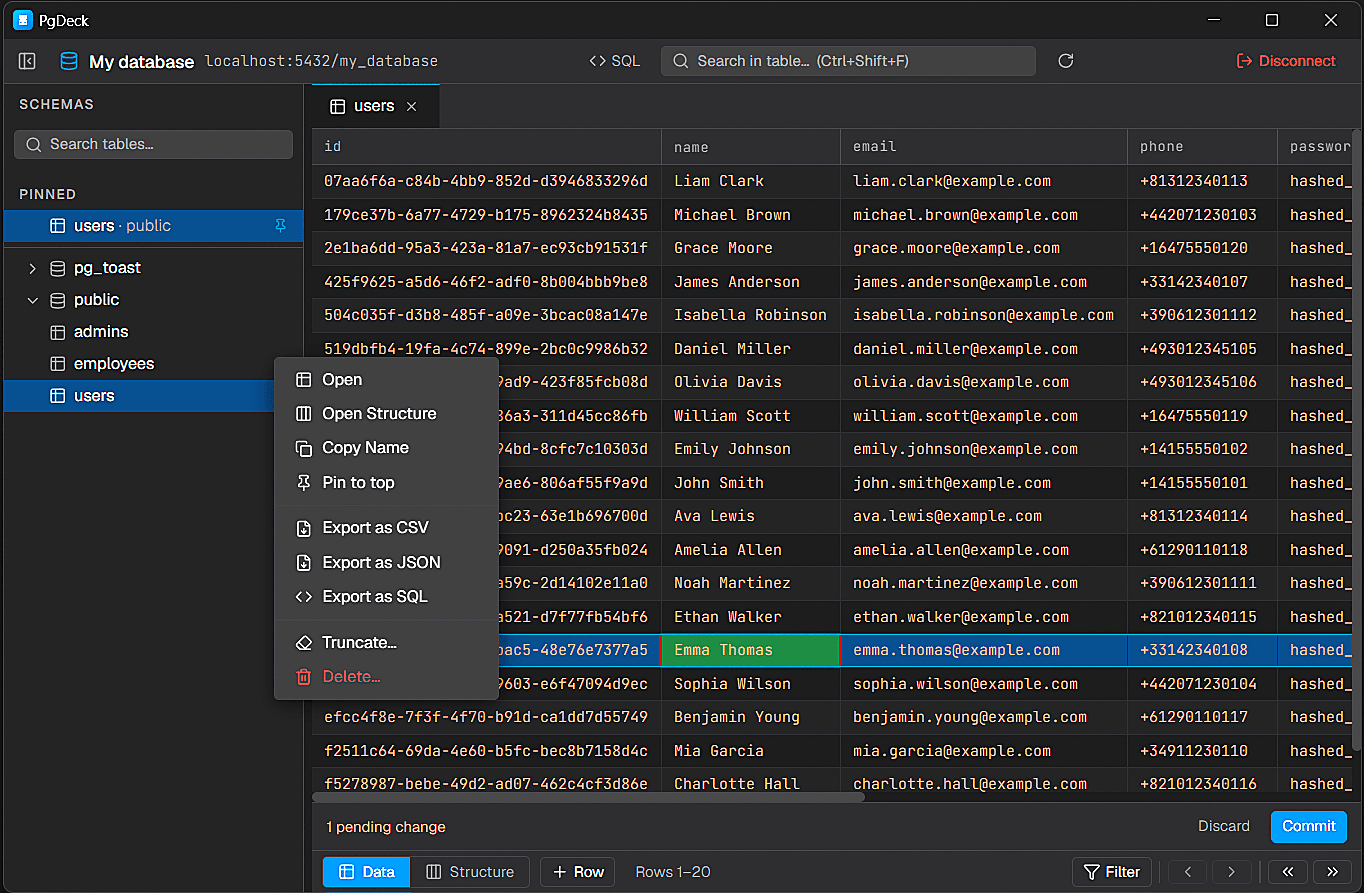
PgDeck is shaped around PostgreSQL tasks that happen every day: connect, inspect, filter, edit, query, manage structure, copy, and export.
Best for: Developers who mainly read and correct PostgreSQL table data
A native PostgreSQL-only desktop client. Closest to the part of pgAdmin most developers actually use: schema tree, data grid, SQL tabs — without the browser. Row edits are staged as a reviewable set and committed in one transaction, which is the main thing pgAdmin's grid does not do. It replaces none of pgAdmin's administration: no roles editor, no tablespaces, no server configuration, no activity dashboard.
Read the full comparisonBest for: Anyone who works across several database engines, not just Postgres
The most capable free alternative and the only one on this list that handles eighty-plus engines and cross-engine data transfer. It covers a good share of pgAdmin's administrative surface too. The trade is weight: it runs on Java and the Eclipse platform, and the interface has to describe every engine it supports, so Postgres-specific work sits inside a much larger tool.
Read the full comparisonBest for: Developers who want one polished native app for several engines
Well-built native client with a strong reputation for interface quality, covering PostgreSQL alongside MySQL, SQLite, Redis and more. Good replacement for pgAdmin's data browsing. No ERD and no bundled backup tooling, and the free version limits open tabs rather than offering a usable tier, so evaluating it properly means buying it.
Read the full comparisonBest for: Teams already standardised on JetBrains IDEs
The strongest SQL editor of any tool here: real completion, refactoring, and code analysis across your schema. If your team already pays for an IntelliJ or PyCharm licence, the consistency is worth a lot. It is a full IDE, so it carries IDE weight and IDE pricing, and it is aimed at people writing queries rather than people clicking through rows.
Best for: People who want the simplest possible interface
The friendliest UI in this group and genuinely pleasant for straightforward table browsing and queries across several engines. Deliberately shallow by comparison: less depth on schema introspection and administration than pgAdmin or DBeaver, which is the point if simplicity is what drove you away from pgAdmin in the first place.
PgDeck is an independent PostgreSQL desktop client. This page compares PgDeck with pgAdmin to help developers understand differences in workflow, interface, and product focus.
| PgDeck | DBeaver | TablePlus | pgAdmin 4 | |
|---|---|---|---|---|
| Native desktop app | Yes | Yes | Yes | No |
| PostgreSQL-only interface | Yes | No | No | Yes |
| Free version you can work in | Yes | Yes | No | Yes |
| Staged edits reviewed before commit | Yes | Partial | Partial | No |
| ERD relationship diagram | Yes | Yes | No | Yes |
| Backup and restore built in | Yes | Yes | No | Yes |
| SSH tunnel connections | Yes | Yes | Yes | Yes |
| Server roles and configuration | No | Partial | No | Yes |
| Other database engines | No | Yes | Yes | No |
Assessed September 2026 against each tool's freely available edition. Vendors change features; if a row here is wrong, tell us and we will correct it.
Save PostgreSQL connection details with encrypted passwords, SSL settings, URL import, testing, search, edit, and delete actions.
Browse schemas and tables, search the table list, pin favorites, filter rows, sort columns, resize columns, and paginate results.
Run SELECT and non-SELECT statements from multi-tab SQL editors with syntax highlighting and interactive query results.
Edit cells, add rows, duplicate rows, set NULL, stage deletes, review pending changes, and commit everything in one transaction.
pgAdmin is two products sharing a window: an administration console for roles, tablespaces, configuration, and server monitoring, and a data tool with a schema tree, a grid, and a query editor. If you only ever touch the second half, every tool on this page replaces it. If you touch the first half, keep pgAdmin installed regardless of what else you choose — no alternative here covers it properly.
pgAdmin 4 is a web application, and the desktop package is a bundled server plus a browser view. Panels reload, tab state is fragile, and a large result set feels heavier than the query that produced it. Every alternative on this page is a native application, which is why 'pgAdmin is slow' and 'pgAdmin alternative' are so often the same search.
pgAdmin is free and open source permanently, with no tier above it and no vendor able to change that. DBeaver's Community Edition comes closest. PgDeck has a free tier and a 30-day Pro trial with no card, but Pro is paid. Be clear with yourself about whether cost or the browser was the actual problem, because only one of those has a free answer.
Adding, renaming, retyping, and dropping columns is available, but every structure action shows the SQL it is about to run and asks for confirmation first. That is deliberately slower than a one-click DDL editor: structure changes are the ones you cannot undo with another UPDATE.
More on choosing, comparing, and running a PostgreSQL desktop client.
It depends which part of pgAdmin you are replacing. For daily PostgreSQL table work in a native app, PgDeck. For multiple database engines, DBeaver. For a polished multi-engine native client, TablePlus. For a JetBrains-consistent SQL IDE, DataGrip. For the simplest possible interface, Beekeeper Studio.
DBeaver Community Edition is the strongest free option and is open source. Beekeeper Studio has a free Community Edition. PgDeck has a free tier covering two saved connections, schema browsing, filters, a basic SQL editor, and CSV/JSON export, plus a 30-day Pro trial with no card required.
No. PgDeck has no roles and privileges editor, no tablespace management, no server configuration UI, and no activity dashboard. It replaces the schema tree, data grid, query tool, and export workflows that most developers use daily.
Most commonly because pgAdmin 4 runs in a browser and feels heavy for routine table work, and because its data grid writes edits directly rather than letting you review a set of changes before committing them.
Yes. It inspects columns and indexes and can add, rename, retype, and drop columns. Each structure action shows the SQL it will run and requires confirmation before executing.
PgDeck is not affiliated with pgAdmin, DBeaver, TablePlus, DataGrip, Beekeeper Studio, or their respective owners. All product names, trademarks, and registered trademarks are property of their respective owners. Comparisons describe each tool as we understand it at the date noted on the table; if something here is out of date, tell us and we will correct it.