Secure connections
Save PostgreSQL connection details with encrypted passwords, SSL settings, URL import, testing, search, edit, and delete actions.
PgDeck vs DataGrip
These tools barely overlap. DataGrip is a database IDE built for writing SQL; PgDeck is a desktop client built for reading and correcting data. Comparing them fairly means being clear that one of them wins the SQL-authoring comparison outright, and it is not ours.
Short answer: Choose DataGrip if you write complex SQL against schemas you have not memorised — its completion, refactoring, and code analysis are the best available and PgDeck has no equivalent. Choose PgDeck if PostgreSQL is your only engine and your day is reading tables, filtering them, and correcting rows, where an IDE is more tool than the task needs.
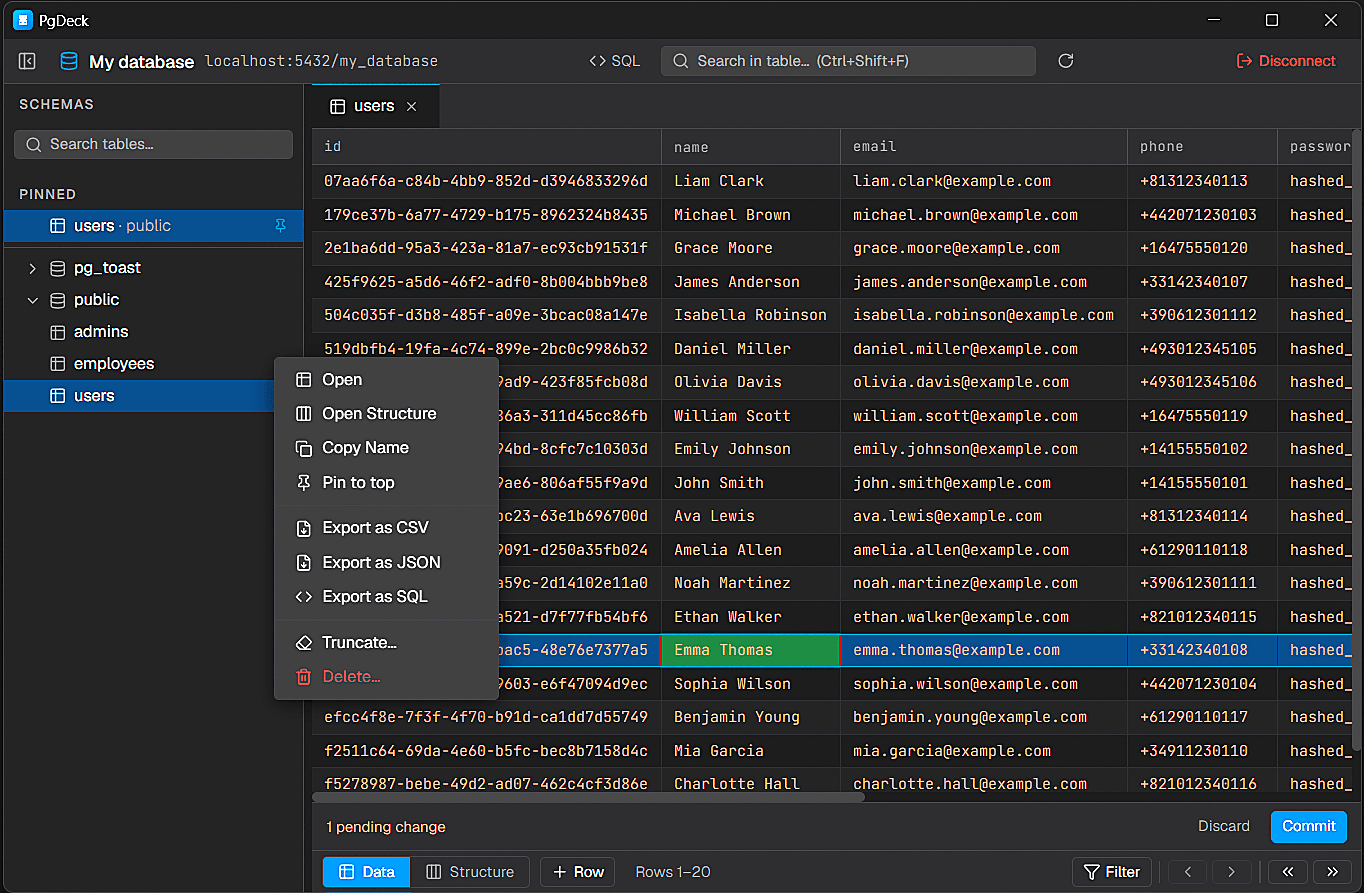
PgDeck is shaped around PostgreSQL tasks that happen every day: connect, inspect, filter, edit, query, manage structure, copy, and export.
PgDeck is an independent PostgreSQL desktop client. This page compares PgDeck with DataGrip to help developers understand differences in workflow, interface, and product focus.
| PgDeck | DataGrip | |
|---|---|---|
| Databases supported | PostgreSQL only | Many engines |
| Built as | Native desktop app | IntelliJ platform IDE |
| Pricing model | Free tier, or $6/mo, $59/yr, $99 once | Subscription |
| Free version you can work in | Yes | No |
| Schema-aware SQL completion | Partial | Yes |
| SQL refactoring and code analysis | No | Yes |
| Version control integration | No | Yes |
| Staged edits reviewed before commit | Yes | Partial |
| ERD relationship diagram | Yes | Yes |
| Backup and restore (pg_dump bundled) | Yes | Partial |
| SSH tunnel connections | Yes | Yes |
| Starts without a JVM | Yes | No |
Compared September 2026. JetBrains sets DataGrip's pricing, which falls in later subscription years and includes a perpetual fallback licence. PgDeck is not affiliated with JetBrains.
Save PostgreSQL connection details with encrypted passwords, SSL settings, URL import, testing, search, edit, and delete actions.
Browse schemas and tables, search the table list, pin favorites, filter rows, sort columns, resize columns, and paginate results.
Run SELECT and non-SELECT statements from multi-tab SQL editors with syntax highlighting and interactive query results.
Edit cells, add rows, duplicate rows, set NULL, stage deletes, review pending changes, and commit everything in one transaction.
DataGrip's value concentrates in the editor: completion that knows your columns and joins, refactoring that renames a table across every statement referencing it, and analysis that flags a mistake before execution. PgDeck's value concentrates in the grid: type-aware filters, a column inspector, ILIKE search, and staged edits. If you spend your day typing SQL, DataGrip is the better tool and no feature table changes that.
DataGrip runs on the IntelliJ platform, so it starts a JVM, indexes your schema, and holds memory in proportion to what you have open. That indexing is exactly what powers the completion, so it is a fair trade rather than waste — but it is a trade. PgDeck holds one connection's schema and opens immediately, because it is not trying to do the thing that requires the index.
DataGrip is sold as a subscription with a perpetual fallback licence, and it comes back for renewal each year. PgDeck offers $6/month, $59/year, or $99 once, plus a free tier that does not expire. For an individual paying personally, or a team that finds recurring software spend hard to approve, that difference sometimes matters more than any feature.
Three places. Edits are staged as one reviewable set and committed in a single transaction, rather than saved per grid. pg_dump and pg_restore are bundled, so backup and restore work without a separate PostgreSQL installation on the machine. And the interface only ever describes PostgreSQL, so filters offer true and false for a boolean rather than generic operators. None of these outweigh the SQL editor if SQL authoring is your job.
IntelliJ IDEA Ultimate includes the same database tooling, as do several other JetBrains IDEs. If your team already pays for those licences, DataGrip's functionality may be sitting unused in an editor you have open anyway — worth checking before comparing prices at all.
More on choosing, comparing, and running a PostgreSQL desktop client.
DataGrip is a full database IDE built on the IntelliJ platform, with schema-aware SQL completion, refactoring, code analysis, and version control integration, across many engines. PgDeck is a native desktop client for PostgreSQL only, focused on browsing, filtering, and staged row editing committed in one transaction.
For reading and correcting PostgreSQL data, yes, and it is considerably lighter. For authoring complex SQL it is not — PgDeck has no refactoring, no code analysis, and no version control integration. If those are why you use DataGrip, PgDeck will not replace it.
Yes. PgDeck has a free tier that does not expire, and Pro at $6/month, $59/year, or $99 as a one-time purchase. DataGrip is subscription-only, priced per user per year by JetBrains, though the rate falls in later years and includes a perpetual fallback licence.
It has a multi-tab SQL editor with syntax highlighting, query history, and saved queries, but not DataGrip's schema-aware completion or cross-statement refactoring. That gap is deliberate — matching it would require the schema indexing that makes an IDE heavy.
Neither. DataGrip is engine-agnostic and PgDeck deliberately omits server administration. For roles, tablespaces, server configuration, and monitoring, pgAdmin is the right tool and it is free.
PgDeck is not affiliated with pgAdmin, DBeaver, TablePlus, DataGrip, Beekeeper Studio, or their respective owners. All product names, trademarks, and registered trademarks are property of their respective owners. Comparisons describe each tool as we understand it at the date noted on the table; if something here is out of date, tell us and we will correct it.