Secure connections
Save PostgreSQL connection details with encrypted passwords, SSL settings, URL import, testing, search, edit, and delete actions.
Best PostgreSQL GUI
A PostgreSQL GUI is any tool that replaces psql with a visual schema tree and a data grid. They split into two families — desktop applications you install, and browser-based tools you run on a server — and that split decides more than any feature list does. Written by the PgDeck team, with the downsides of each option included.
Short answer: For a desktop PostgreSQL GUI, PgDeck is the lightest PostgreSQL-only option and DBeaver the most capable free one. For a browser-based GUI, pgAdmin is the most complete and Adminer the smallest. Pick desktop if you want speed and credentials stored locally; pick browser-based if the database sits somewhere you cannot install software.
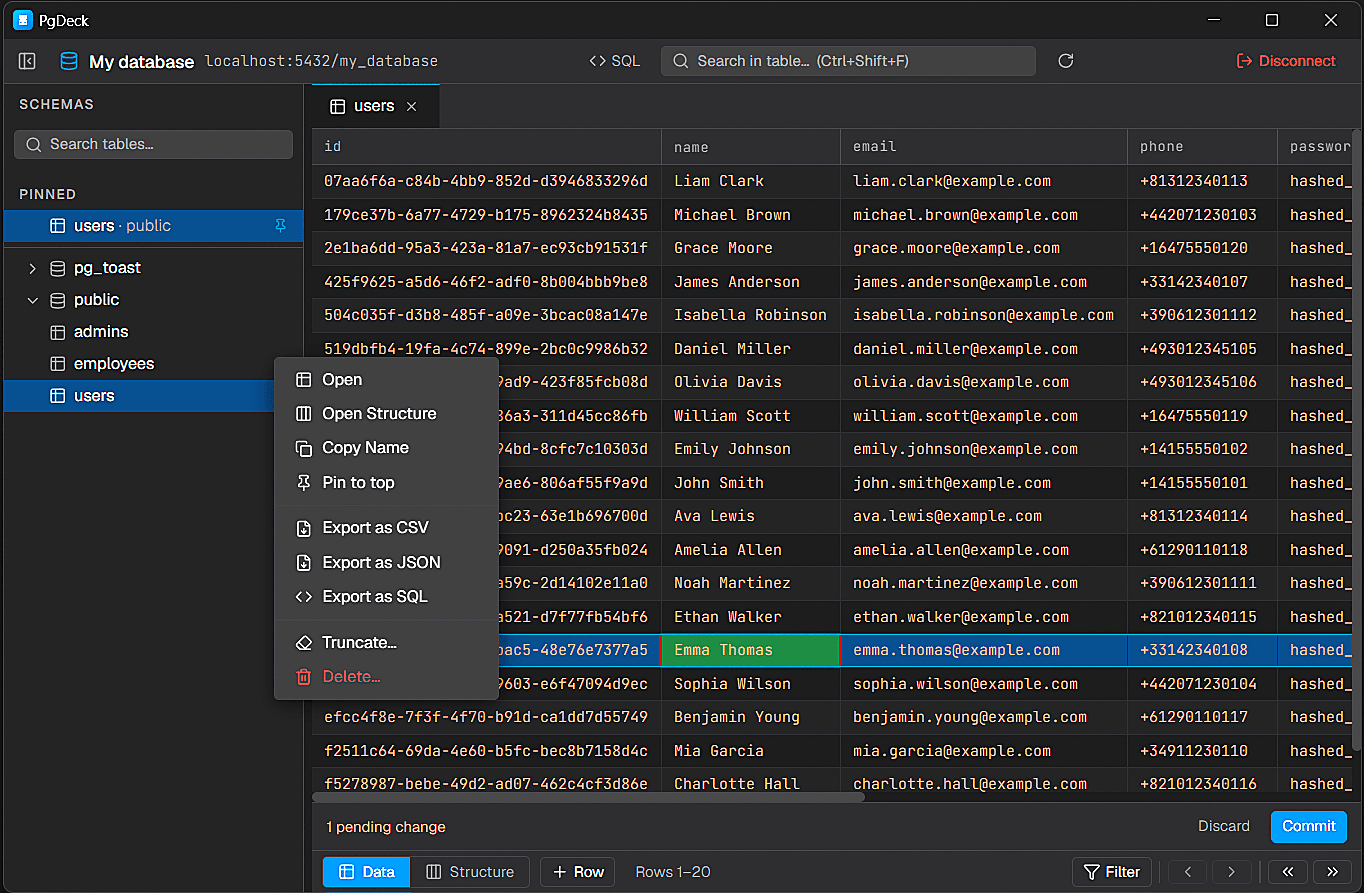
PgDeck is shaped around PostgreSQL tasks that happen every day: connect, inspect, filter, edit, query, manage structure, copy, and export.
Best for: A fast PostgreSQL-only GUI for daily table work
Native desktop app, PostgreSQL only, so the grid, filters, and column inspector speak in Postgres types rather than generic ones. Edits are staged as one reviewable set and committed in a single transaction. Includes multi-tab SQL, query history, ERD, bundled pg_dump backup and restore, and SSH tunnels. No server administration and no other engines.
Read the full comparisonBest for: The most complete GUI, and the standard one
The official PostgreSQL GUI and the most feature-complete: schema tree, query tool, ERD, backup UI, plus the administration surface nothing else matches. Runs as a web application even in its desktop packaging, which is why it feels heavier than a native app for routine browsing. Free permanently, which no commercial tool can promise.
Read the full comparisonBest for: A free GUI covering Postgres and every other engine
The most capable free desktop GUI by a distance, with deep schema tooling, ERD, and cross-engine data transfer across eighty-plus databases. Built on Java and the Eclipse platform, so it starts slower and shows a denser interface than a single-engine client needs.
Read the full comparisonBest for: A polished native GUI across several engines
The best-looking client in this list and genuinely quick. Covers PostgreSQL alongside MySQL, SQLite, Redis and others. No ERD, no bundled backup tooling, and its free version limits open tabs instead of offering a usable tier.
Read the full comparisonBest for: The simplest GUI to hand to someone new
Open source, multi-engine, and the friendliest interface here. A good first PostgreSQL GUI. Deliberately shallow on schema introspection and administration, and being an Electron app it is lighter to read than to run.
Best for: A GUI on a server where you cannot install a desktop app
Adminer is a single PHP file and pgweb is a single Go binary, both giving you a usable schema browser and query runner in a browser tab within minutes. Ideal behind a bastion host or inside a container. Minimal by design — no ERD, no staged editing, no real administration — and anything you expose over the network becomes a credential and access-control problem you now own.
| PgDeck | DBeaver | pgAdmin | Adminer | |
|---|---|---|---|---|
| Type | Desktop | Desktop | Browser | Browser |
| Price | Free tier, Pro paid | Free CE | Free | Free |
| Install needed on your machine | Yes | Yes | Yes | No |
| Runs on a remote server | No | No | Yes | Yes |
| Credentials stored locally | Yes | Yes | No | No |
| Staged edits reviewed before commit | Yes | Partial | No | No |
| ERD relationship diagram | Yes | Yes | Yes | No |
| Server roles and configuration | No | Partial | Yes | No |
| Other database engines | No | Yes | No | Yes |
Assessed September 2026 against each tool's freely available edition. Written by the PgDeck team — judge the PgDeck column accordingly, and tell us if any other row is wrong.
Save PostgreSQL connection details with encrypted passwords, SSL settings, URL import, testing, search, edit, and delete actions.
Browse schemas and tables, search the table list, pin favorites, filter rows, sort columns, resize columns, and paginate results.
Run SELECT and non-SELECT statements from multi-tab SQL editors with syntax highlighting and interactive query results.
Edit cells, add rows, duplicate rows, set NULL, stage deletes, review pending changes, and commit everything in one transaction.
Everything else follows from it. A desktop GUI is faster for the open-a-table-and-look loop, keeps credentials on your own machine in the OS keychain, and works offline against a local database. A browser-based GUI installs nothing locally, which is the only workable answer when the database sits inside a network you can reach but cannot install software on. Decide this before comparing features, because it removes most of the list.
A GUI supporting many engines has to generalise: a filter offers generic operators, search is a generic contains, the column inspector shows generic types. A PostgreSQL-only GUI can offer true and false for a boolean, a date picker for a timestamptz, ILIKE for case-insensitive search, and a JSONB value opened in a real editor. That is the entire practical case for a single-engine tool, and it only matters if Postgres is the only engine you use.
The most consequential difference between PostgreSQL GUIs is barely ever in their feature tables. Some write a cell the moment you leave it. Some hold changes per grid until you save. Some hold the entire pending set — edits, inserts, duplicates, NULLs, deletes — for review and commit it in one transaction. If you ever touch production data, weigh this above ERD support or theme options.
pgAdmin, DBeaver Community Edition, Beekeeper Community Edition, Adminer, and pgweb are free and open source, and no vendor can take that away. PgDeck has a free tier and a 30-day Pro trial that needs no card, but Pro is paid software. If cost is the deciding constraint, the open source options are the honest recommendation and this page will not pretend otherwise.
More on choosing, comparing, and running a PostgreSQL desktop client.
For a free and complete GUI, pgAdmin 4. For a free desktop GUI covering many engines, DBeaver Community Edition. For a fast PostgreSQL-only desktop GUI with staged editing, PgDeck. For a polished multi-engine native app, TablePlus. The right answer depends mostly on whether you want a desktop app or a browser-based tool.
Several. pgAdmin 4, DBeaver Community Edition, Beekeeper Studio Community Edition, Adminer, and pgweb are all free and open source. PgDeck has a free tier with two saved connections, schema browsing, filters, a basic SQL editor, and CSV/JSON export.
No. PostgreSQL ships with psql, a command-line client. pgAdmin is maintained by the same community and is the closest thing to an official GUI, but it is a separate download and not part of a standard server installation.
Desktop is faster for routine browsing and keeps credentials in your own OS keychain. Browser-based is the better answer when the database lives somewhere you cannot install software, such as behind a bastion host, but it means credentials live on a server and access to that server becomes access to the database.
Yes. All of them expose a standard PostgreSQL connection, so any client works. Copy the postgres:// connection URL from the provider's dashboard and paste it into the GUI, making sure SSL is required — hosted providers generally reject unencrypted connections.
PgDeck is not affiliated with pgAdmin, DBeaver, TablePlus, DataGrip, Beekeeper Studio, or their respective owners. All product names, trademarks, and registered trademarks are property of their respective owners. Comparisons describe each tool as we understand it at the date noted on the table; if something here is out of date, tell us and we will correct it.