PgDeck

pgAdmin vs TablePlus

pgAdmin vs TablePlus for PostgreSQL.

This is the clearest trade-off in PostgreSQL tooling: a free, complete, browser-based administration tool against a paid, polished, native multi-engine client. Almost nobody is genuinely torn between them once they work out which half of the job they do.

Short answer: Use pgAdmin if you administer PostgreSQL, or if the tool must be free — it covers roles, tablespaces, configuration, and monitoring, and nothing else here comes close. Use TablePlus if you spend your day reading and editing data across several engines and want a fast native app, and the licence cost is acceptable. The two are complements more often than alternatives.

Written by the PgDeck team. We make a PostgreSQL client, so we have a stake in this — the comparison below is about the two tools in the title, and where we fit is set out at the end.

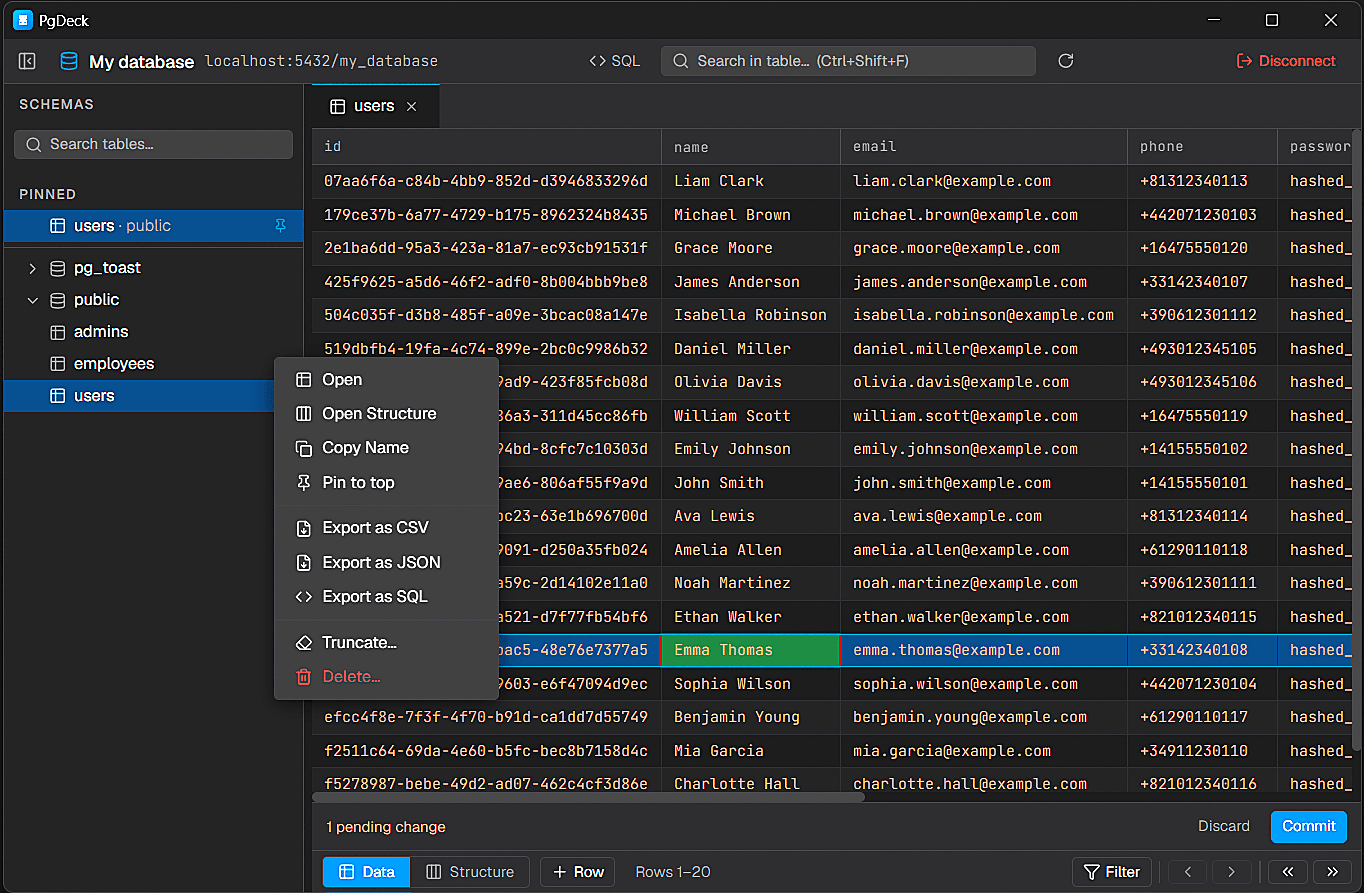
PgDeck PostgreSQL desktop client with schema navigation, table filtering, row editing, and SQL tools

What this comparison covers

The differences that change which tool you should install, rather than the ones that only lengthen a feature list.

pgAdmin is free forever; TablePlus is a paid licence with a limited trial
pgAdmin is PostgreSQL-only; TablePlus covers several engines
Only pgAdmin does server administration and monitoring
TablePlus is a native app, so routine browsing feels quicker
Neither tool stops you from using the other alongside it
pgAdmin 4 vs TablePlus
pgAdmin 4TablePlus
PriceFree, open sourcePaid licence
Free versionEntirely freeTrial, open-tab limit
Databases supportedPostgreSQL onlyMultiple engines
Runs asWeb app in a browserNative desktop app
Roles, privileges, tablespacesYesNo
Server configuration editingYesNo
Server activity dashboardYesNo
Backup and restore UIYesNo
ERD relationship diagramYesNo
SSH tunnel connectionsYesYes
Speed of routine table browsingPartialYes
Where credentials are storedServer-side configLocal, on your machine

Compared September 2026. TablePlus is commercial software and its trial terms and feature set are set by its vendor. Neither project is affiliated with PgDeck, who wrote this page.

They are built for different halves of the job

pgAdmin is an administration console that also shows table data. TablePlus is a data tool with no administration at all — no roles editor, no tablespaces, no configuration, no activity dashboard. If you need to grant a privilege or check what is blocking a query, TablePlus will not help and pgAdmin will. If you need to read three hundred rows and correct four of them, the reverse is closer to true.

What you are paying for

TablePlus's licence buys interface quality and native speed across several engines, not features pgAdmin lacks. That is a real thing to buy — a tool you open forty times a day being pleasant is worth money — but it is worth being clear that you are paying for the experience rather than capability. On pure feature count, the free tool wins.

The trial makes evaluation awkward

TablePlus's unlicensed version limits how many tabs you can keep open, which is a nudge to purchase rather than a tier you can work in. That makes a genuine multi-week comparison against pgAdmin difficult: you end up judging a constrained version against a complete one. Factor that in rather than concluding too quickly from a short trial.

Browser versus native, concretely

pgAdmin 4 is a web application even when installed as a desktop package — it bundles a server and a browser view. That shows up as panel reloads, fragile tab state, and large result sets feeling heavier than the query behind them. TablePlus is a genuine native application, which is why the comparison so often comes down to how a tool feels rather than what it does.

Multi-engine matters or it does not

TablePlus covers MySQL, SQLite, Redis, SQL Server and more. If your stack has a cache and a legacy database next to Postgres, that alone can justify the licence. If PostgreSQL is the only engine you have opened in six months, you are paying for reach you do not use, and the comparison narrows to speed and interface.

The common resolution

Teams that buy TablePlus usually keep pgAdmin installed anyway, because the administration gap does not go away. Teams that stay on pgAdmin usually do so because it is free and complete, and accept the browser overhead. Both are defensible. What is not defensible is buying a licence expecting it to replace the administration half.

Is TablePlus better than pgAdmin?

For reading and editing data it is faster and more pleasant, because it is a native application rather than a web one. For administration it is not comparable — TablePlus has no roles editor, no tablespace management, no server configuration, and no activity dashboard. Which is better depends entirely on which of those you do.

Is TablePlus worth paying for when pgAdmin is free?

If you spend hours a day in a data grid across several database engines, many developers find the native speed and interface worth the licence. If you mainly administer a single PostgreSQL server, you would be paying for an experience upgrade on the half of the job TablePlus does not cover.

Does TablePlus do PostgreSQL administration?

No. It has no interface for roles and privileges, tablespaces, server configuration, or session monitoring, and no backup and restore UI. You can run the SQL yourself, but there is no managed surface for it the way pgAdmin provides.

Is there a free version of TablePlus?

There is a trial that limits how many tabs you can keep open at once. It is a prompt to purchase rather than a free tier you can work in indefinitely, which makes a long side-by-side evaluation against pgAdmin harder than it looks.

Can I use pgAdmin and TablePlus together?

Yes, and many people do. Both connect over the standard PostgreSQL protocol and neither installs anything into the database. Using pgAdmin for administration and TablePlus for daily data work is a common arrangement.

PgDeck is not affiliated with pgAdmin, DBeaver, TablePlus, DataGrip, Beekeeper Studio, or their respective owners. All product names, trademarks, and registered trademarks are property of their respective owners. Comparisons describe each tool as we understand it at the date noted on the table; if something here is out of date, tell us and we will correct it.